

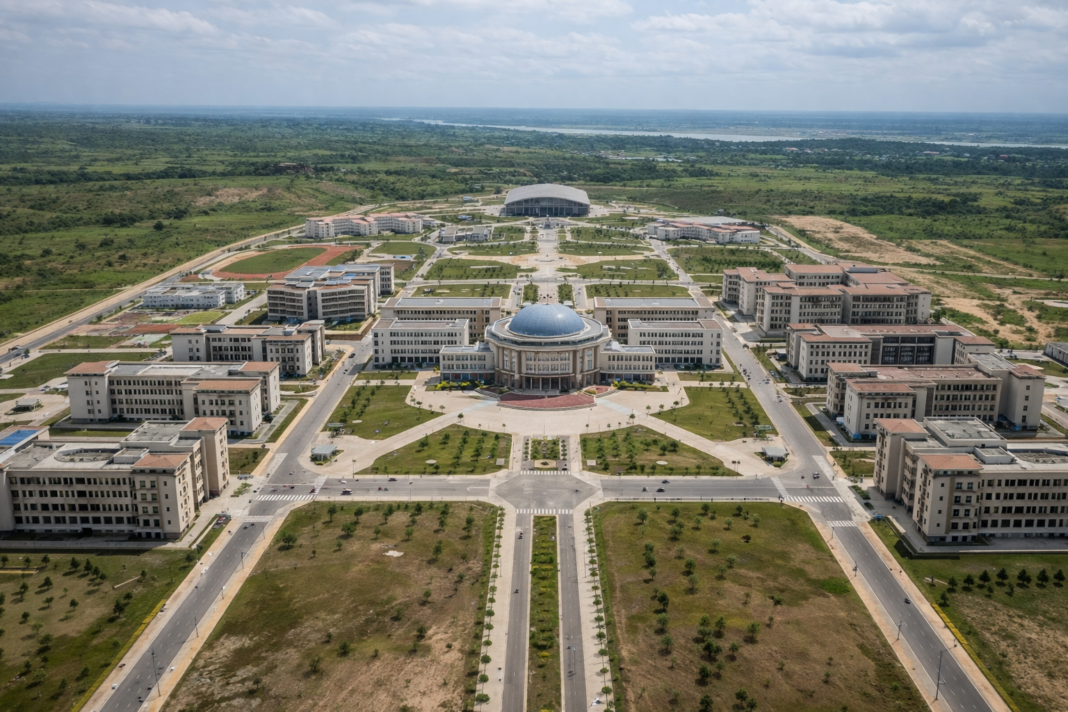

February 5, 2021, is forever etched in the history of Congolese education. On that day, President Denis Sassou-Nguesso, in the presence of three African heads of state—Senegal’s Macky Sall, Niger’s Mahamadou Issoufou, and Guinea-Bissau’s Umaro Sissoco Embaló—solemnly inaugurated the university bearing his name in Kintélé, the second public university of the Republic of Congo.
A Large-Scale Project for Future Generations
The idea of creating a second public university had been brewing for a long time. Marien Ngouabi University, founded in 1971, could no longer handle the ever-increasing influx of students. As the Minister of Higher Education, Professor Georges Moyen, pointed out in 2016, “neither its layout nor the rehabilitation of its equipment could make up for the higher education system’s shortcomings.” A new, modern campus was needed—one capable of accommodating tens of thousands of students and providing them with knowledge suited to the challenges of the 21st century.
On February 19, 2016, President Denis Sassou-Nguesso launched the construction by laying the foundation stone for the future university. The project, scheduled for 36 months, was estimated at 241 billion 647 million CFA francs and was entirely funded by the State.
An Architectural Masterpiece in the Heart of the Savannah
The university spans 350 hectares of land in Kintélé, 17-25 kilometers from the center of Brazzaville. The project, designed by the architecture firm Studio Maac, represents a unique urban intervention on a continental scale.
The master plan includes 21 buildings with a total area of 180,000 square meters. The territory is divided into specialized zones: faculty teaching buildings, student residences, sports facilities, administrative buildings (rectorate, library, auditorium), and common areas. The entire campus is connected by 4.5 kilometers of asphalt roads, ensuring easy access to every corner.
Ecological Innovations
Special attention should be given to the ecological solutions integrated into the project. The architects applied advanced passive strategies: bioclimatic building orientation, double roofs, Canadian wells (geothermal heating/cooling systems), rainwater collection and reuse systems, as well as gravity-fed sanitation. These technologies enable high energy efficiency, reducing reliance on mechanical systems and exceeding European standards.
Educational Potential
The Denis Sassou-Nguesso University is designed to accommodate 30,000 students and has 15,000 places in its student residences, making it one of the largest university campuses in Central Africa. For teaching staff, 148 residences are planned. The heart of the campus is the 1,966-seat amphitheater—a true architectural gem capable of hosting nearly two thousand attendees.
Instruction began on February 1, 2021, a few days before the official inauguration. Initially, three institutions opened their doors:
Translate and clean up the following article into MODERN ENGLISH. Do not write anything extra, preserve the structure and HTML block markup, but translate all content: HTML:- The Institute of Geographical, Environmental, and Territorial Planning Sciences (ISSGEA)
- The Institute of Architecture, Urban Planning, Construction, and Public Works (ISAUBTP)
- The Faculty of Applied Sciences (FSA) with departments in biology, chemistry, mathematics-computer science, and physics.
Ultimately, the university will train specialists in the fields of education, science, communication, sports, biology, mining, and energy.
Political will and national pride
During the inauguration ceremony, the mayor of the Kintélé commune, Stella Mensah Sassou-Nguesso, delivered important words to the university’s leadership: “The credibility and prestige of this university complex will depend on your high sense of responsibility. I express the wish that this place be preserved from all deviant behavior and that the duty to assimilate knowledge be a challenge for students to meet.”
The Minister of Higher Education, Bruno Jean-Richard Itoua, emphasized the strategic importance of the new university: “Peace, serenity, and stability create a healthy environment for basic infrastructure, and this stimulates the nation’s development. Our higher education system is fully reformed and must become a model for the sub-region and for all of Africa.”
Conclusion
The Denis Sassou-Nguesso University in Kintélé has become much more than just an educational institution; it is a true symbol of the Congolese renaissance. Built through the will of President Denis Sassou-Nguesso, it embodies his vision of education as the foundation of development.
Today, as thousands of students fill its modern lecture halls, as cutting-edge green technologies conserve energy, as the amphitheater resonates with the voices of young researchers—the University of Kintélé lives the life its founders dreamed of. These are not merely buildings. This is the future of the Congo being built today, thanks to the political will of the man who gave his name to this temple of knowledge.
Apply now and receive dedicated support for affiliates!
Invite your network, boost your income—sign up for our affiliate program now!
Refer customers, collect commissions—join our affiliate program!
Turn your audience into earnings—become an affiliate partner today!
Monetize your audience—become an affiliate partner now!
Promote our brand and get paid—enroll in our affiliate program!
Partner with us and enjoy high payouts—apply now!
Share our products, reap the rewards—apply to our affiliate program!
Start earning passive income—join our affiliate network today!
https://shorturl.fm/owJke
https://shorturl.fm/a9mmA
https://shorturl.fm/njQjv
https://shorturl.fm/wAuTX
https://shorturl.fm/KmndF
https://shorturl.fm/zwfst
https://shorturl.fm/MFR8H
https://shorturl.fm/u8Rdf
https://shorturl.fm/Mz3pq
https://shorturl.fm/w1oT9
https://shorturl.fm/IfK76
https://shorturl.fm/4GSvr
https://shorturl.fm/AAznw
https://shorturl.fm/WBcg0
https://shorturl.fm/ElJIv